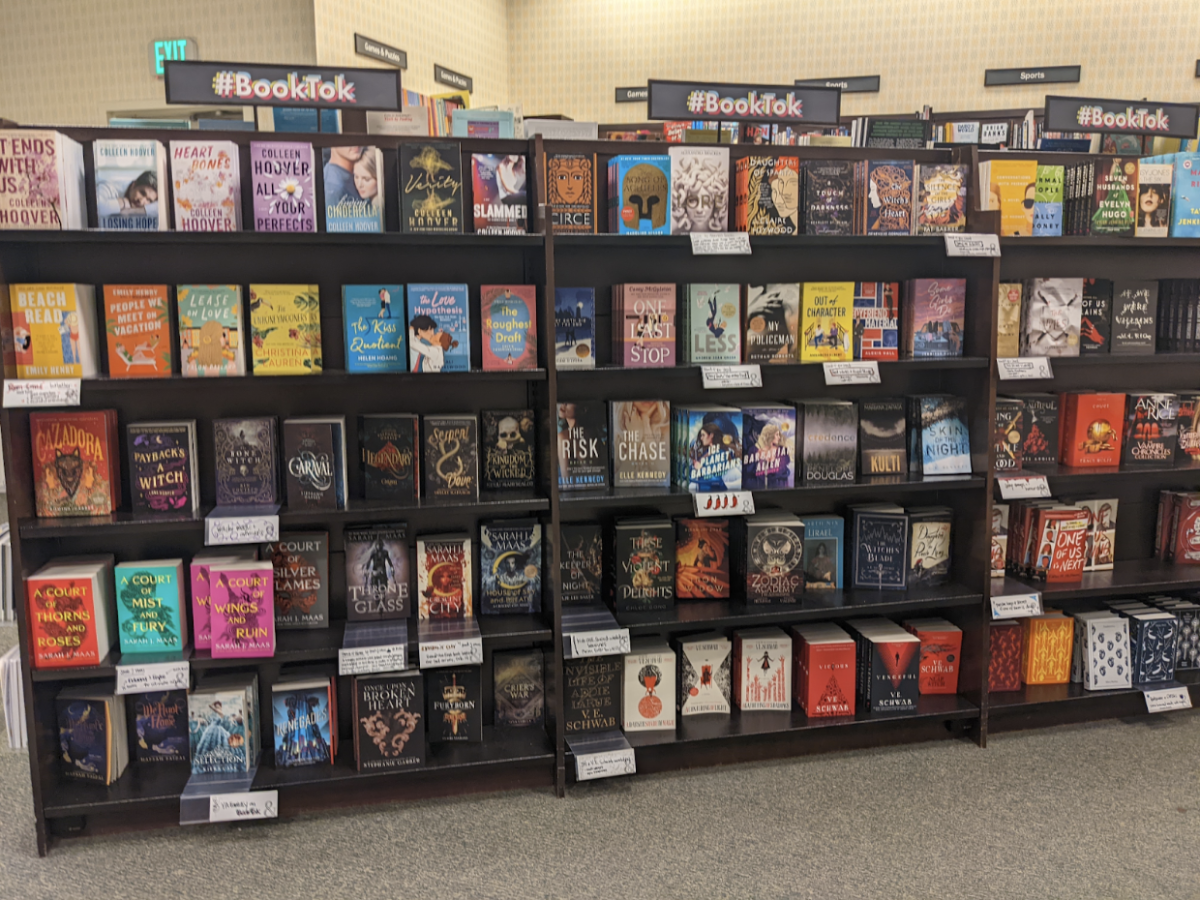
BookTok has turned literature into a prop, elevating how books look over what they actually say. Emerging during the 2020 quarantine era, Booktok has made its way into the lives of many young readers on TikTok. It acts as a massive online book club where readers can share their thoughts, favorite novels, and recommendations. On the surface, it seems fun and harmless: shiny bookshelves filled with cartoon-style covers and pages covered with color coordinated sticky tabs, visual proof that the so-called bookworm has “really” read the book. But this new aesthetic of reading has ended up weakening the nuanced and complex aspects of literature.
In Barry Peirce’s GQ article, “In the shallow world of BookTok, being ‘a reader’ is more important than actually reading,” he reflects on his time making BookTube videos in the 2010s. BookTube, like BookTok, is a space where readers post book hauls, reviews, and reading challenges on YouTube. At first, it was a genuine and wholesome online community but quickly became commercialized. Peirce describes how BookTubers became “pawns in the hands of publishing houses.” These publishing houses would send BookTubers boxes of new releases for them to show off, only to be never mentioned again. Pierce describes this shift by saying, “the act of reading became replaced by the act of being a reader.” In other words, reading became more about performing than actually engaging with books.
Rhiannon Lucy Cosslett makes a similar point in The Guardian, she argues that owning books has become cult-like. Her claims can be applied to BookTok. She writes that people “treat books like totemic, magical objects,” using them to project intelligence or an academic lifestyle. She adds that owning a lot of books does not equate to actually knowing things. Many forget that reading doesn’t require buying brand-new paperbacks. Going to a local library or buying second-hand are more sustainable alternatives and can help support small businesses rather than large corporations.
Instead of focusing on the books themselves, many BookTok creators share ways to romanticize the idea of reading. Whether it be wearing a cute outfit, going to an aesthetic cafe, or having pretty annotations these posts help influencers present themselves as dedicated readers. Meanwhile, the books they recommend are easy to digest and sensational, often relying on predictable storylines, familiar character types, and neatly wrapped endings. The popularity of these books tells publishers exactly what sells fastest, which leads them to produce the same types of novels. This also explains why publishing houses will reach out to BookTok creators to promote new releases, books that have been consciously written to go viral on social media.
Writers are affected by BookTok as well. Many writers feel pressured to produce novels that will appeal to BookTok’s fast-moving trends rather than focus on authentic storytelling. Since certain tropes tend to get more attention on social media, authors may feel obligated to simplify their writing or prioritize shock value just to keep up. The push to create mass-marketable stories results in books that feel repetitive or uninteresting. Overtime, this cycle harms both authors and readers by reducing the diversity of stories being published and limiting nuance within current literature.




![[Donald Trump] by [Gage Skidmore] is licensed under [CC BY-SA 2.0]](https://flhsprospect.com/wp-content/uploads/2026/01/silencing-the-press-1200x964.jpg)
![[Charlie Kirk] by [Gage Skidmore] is licensed under [CC BY-SA 2.0].](https://flhsprospect.com/wp-content/uploads/2025/09/charlie-kirk-article-1200x800.jpg)