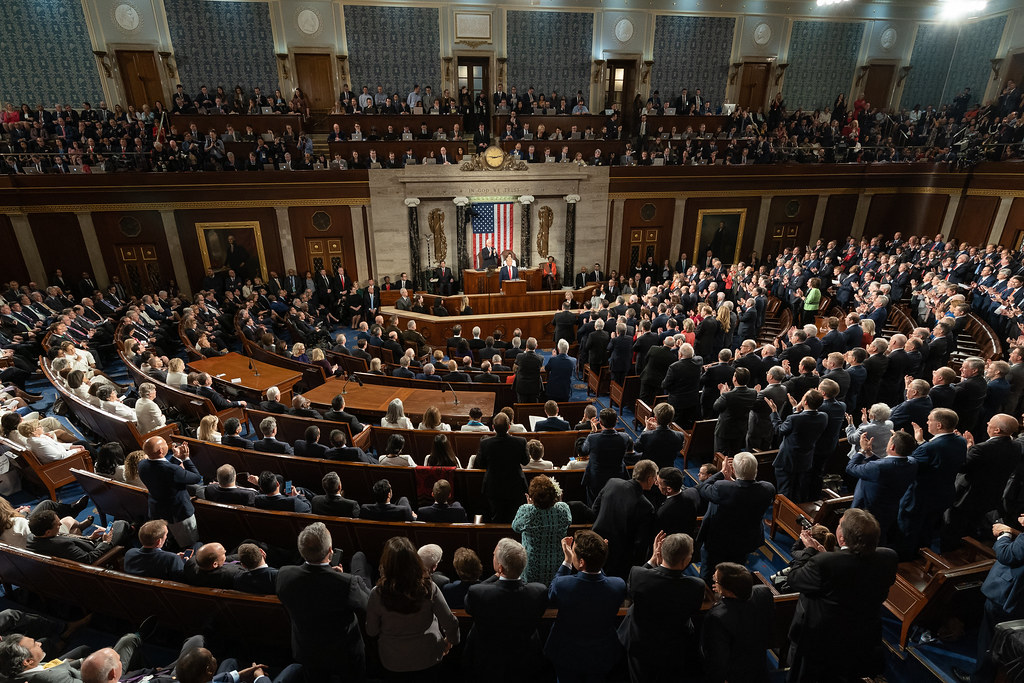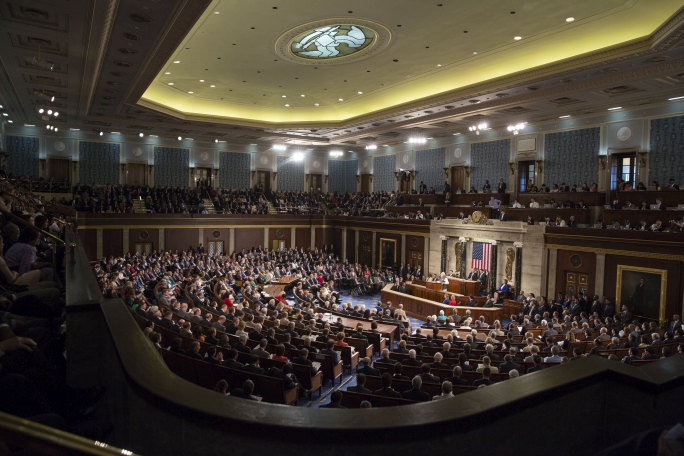
The U.S. Constitution reared its ugly head on Wednesday as 352 members of the House of Representatives decried war as “bad” in a bipartisan resolution.
If approved in the Senate, the federal government—which, readers should note, includes more than just the executive branch… yes, still—will define all future military conflicts differently. To quote from the groundbreaking statement included in the legislation, “war, as a general concept, is bad.”
The sentiment comes during renewed conversation in the United States about the extent of presidential power. In 1973, Congress passed the War Powers Resolution to limit then-President Richard Nixon’s ability to deploy American troops to Vietnam, as the legislature (allegedly) has the exclusive Constitutional power to declare war.
That bill suggests, but does not insist, that the president must notify Congress about emergency mobilization of the Armed Forces within 48 hours, and that the American military can only remain deployed for 60 days without formal authorization. It has also been demonstrated that absolutely nothing can be done if-slash-when these provisions are violated, because consequences aren’t real and neither was the Vietnam War.
The new bill, known as the “Whose Power is it, Anyway? Resolution,” began in the House Committee on Foreign Affairs. Supporters in the rest of Congress crawled out of the woodwork after a military operation in Venezuela on January 3rd. There, American intervention resulted in the removal of President Nicolas Maduro by American troops.
Despite the mission’s wild success, Democratic lawmakers denounced the Trump administration for bypassing Congress. Senator Chris Murphy (D-CT) (CONNECTICUT REPRESENT!! [AIRHORN SFX]) called the action in Venezuela “illegal” and “an enormous distraction from what actually matters to the people of this country.”
Debate on the House floor over the resolution lasted twenty-one hours, which is long enough to watch All Quiet on the Western Front (2022) eight times. The controversy was centered around the appropriate definition of ‘war.’
Although most members of the chamber were satisfied with the one later printed in the resolution, “a prolonged armed conflict between different groups, ignoring that time we were in Vietnam,” a small and enthusiastic faction advocated for an alternative definition: “a theoretically infinite tabletop game suitable for children.”
“My grandma is obsessed with war,” argued one Democratic congresswoman, “and she’s not evil. She’s not even that bad; she just hobbles across the street when she sees people of color using the same sidewalk, but sometimes she doesn’t even notice them!”
Asked by a colleague if she was thinking of War, the card game, the representative said, “Ohhhhh.” The perfectly understandable confusion was cleared up, and the proposal cleared the House with a strong majority shortly thereafter.
There were 70 abstentions. When questioned about why they declined to participate in such an important vote, each of the nonvoting congresspeople placed one finger to their lips and pointed to a nearby poster reading “Big Brother is watching you.”
Some readers will notice that 352 and 70 do not add up to 435 (cool it, Stephen Hawking), leaving 13 votes cast by American representatives to oppose the resolution that war is bad.
Reflected one dissenting lawmaker (R-I forgot to ask), “It’s a slippery slope. If we’re saying war is ‘bad,’ and the president can’t order the entire U.S. military to wherever he wants, then how else are we supposed to acquire Greenland?”
Similar attempts have previously been made to push through sweeping amendments to the 1973 War Powers Resolution, or to introduce completely new legislation, with limited success. This pending bill is the first such effort to garner widespread support. It is being hailed by international peacekeeping organizations as revolutionary for international affairs with America.
The Senate is not expected to pass the resolution.